
 EN
EN
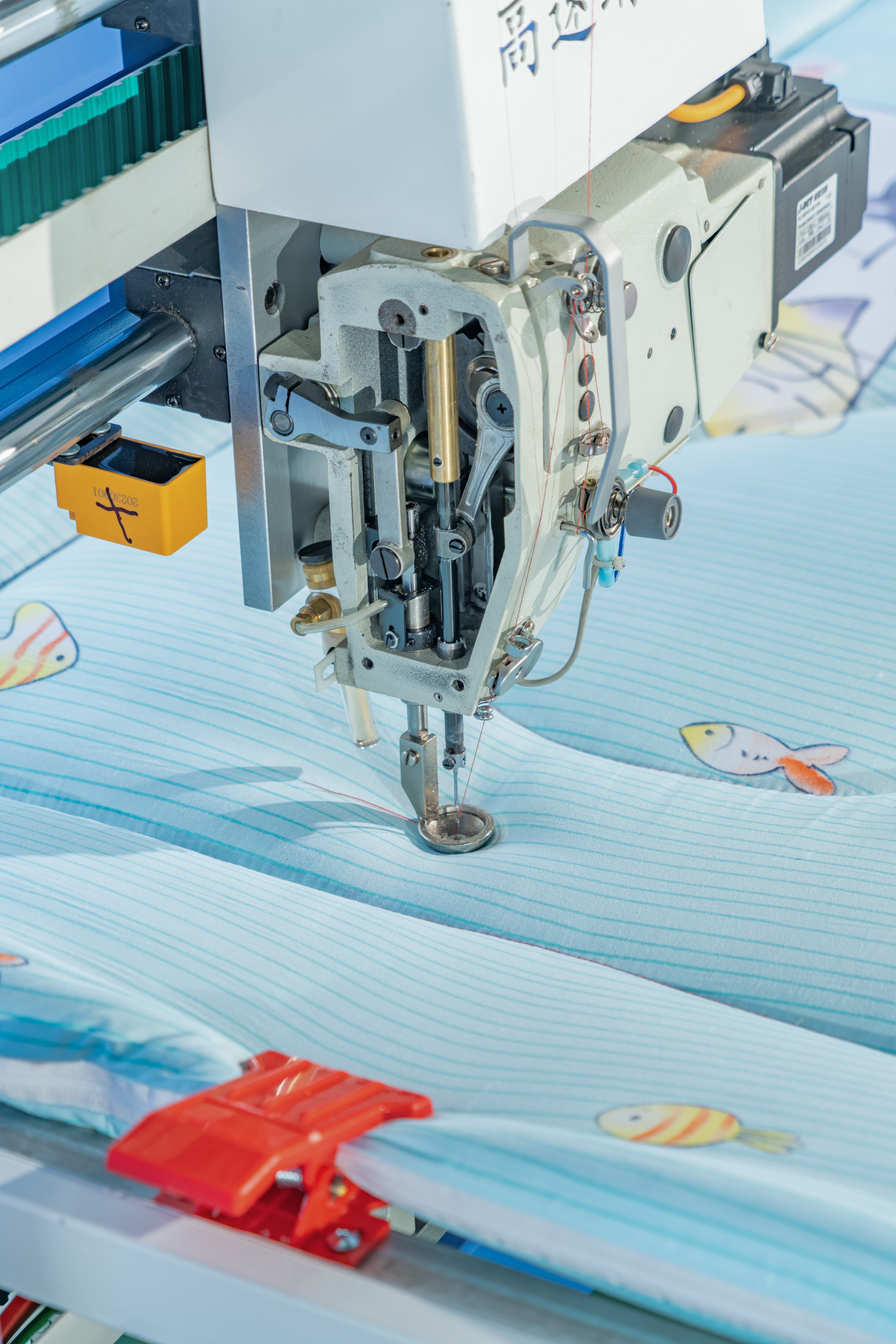
How Single-Needle and Multi-Needle Quilting Machines Work Differently
Mechanical Design and Stitch Formation Fundamentals
The core engineering difference lies in how motion is distributed. A single-needle quilting machine uses a stationary fabric bed and a dynamic sewing head that moves on a multi-axis gantry, tracing programmed patterns while fabric layers remain clamped in place. This enables continuous, free-motion stitching in any direction—without rotating the material.
In contrast, a multi-needle quilting machine operates on a fixed-row principle: a horizontal needle bar (typically holding 11 to 23 needles) remains stationary, while synchronized rollers feed fabric continuously beneath it. All needles stitch simultaneously, forming parallel rows of lock-stitches. Mechanically simpler for straight-line and large-scale patterns, this design cannot replicate the directional agility of a single-head system. The fundamental trade-off is clear: single-needle systems prioritize geometric freedom; multi-needle systems maximize throughput by forming many stitches in one pass.
Precision, Tension Control, and Detail Handling in Single-Needle Quilting Machines
The single-needle quilting machine excels at intricate detail. Its ability to perform 360° jump stitches—with sub-millimeter stop/start accuracy—makes it ideal for complex custom work. Because only one needle is active at a time, operators can fine-tune top and bottom thread tension specifically for that needle and thread path, ensuring balanced, clean stitches even on tight curves and sharp corners.
This precision is essential for high-value applications like decorative border quilting or integrated logos. For example, a leading luxury bedding manufacturer reduced material waste by 15% after switching to a single-needle system for its flagship line—programmed pattern accuracy eliminated stitch-out errors on expensive cover fabrics. The machine’s consistent needle penetration and loop formation also handle dense seam intersections more reliably than fixed multi-needle bars. Where aesthetic quality justifies the time investment, the single-needle’s detail handling remains a decisive competitive advantage.
Matching the Quilting Machine Type to Your Production Scale and Goals
Hobbyist, Small Studio, and Custom Work: Why a Single-Needle Quilting Machine Often Fits Best
For workshops, designers, and custom quilt makers, the single-needle quilting machine is often the most practical choice. Its stitch-by-stitch control supports complex patterns, intricate free-motion designs, and precise 360° jump-stitch placement for borders or logos. Small-batch production—typically between 50 and 500 units—frequently demands frequent pattern changes, and a single-needle machine can be reprogrammed in minutes without mechanical recalibration. Its lower upfront cost and compact footprint suit limited studio space, while gentle fabric handling minimizes shifting of delicate materials. Operators can adjust tension per design, ensuring every heirloom piece or limited-edition panel meets exacting detail standards. When creativity and flexibility outweigh sheer volume, the single-needle delivers unmatched versatility and a manageable entry point into professional quilting.
High-Volume Contract Production and Commercial Quilting: Where Multi-Needle Quilting Machines Deliver ROI
When production scales to 1,000+ identical units per batch, the multi-needle quilting machine becomes the engine of profitability. By stitching multiple lines simultaneously, it slashes cycle times and delivers uniform seam quality across every panel. With minimal pattern variation, its high-speed, automated operation drastically reduces labor per unit—and its robust build supports continuous, heavy-duty runs. Though the initial investment and floor-space requirements are larger, rapid output quickly offsets those costs: a typical large-scale operation can complete a full shift’s output in a fraction of the time needed by a single-needle system. ROI is further amplified by lower per-piece maintenance and fewer operator interventions. For contract manufacturers, mattress producers, and commercial upholstery lines, the multi-needle quilting machine is the definitive tool for meeting tight deadlines and turning high-volume orders into a reliable, margin-driven business.
Key Practical Factors When Choosing Your Quilting Machine
Upfront Cost, Floor Space, Operator Training, and Long-Term Scalability
Practical factors like cost, space, training, and growth potential often determine the best fit. A single-needle quilting machine carries a lower upfront investment—typically under $5,000—and fits comfortably on a standard craft table, making it ideal for home studios or small workshops. Operator training is minimal; most users master basic quilting within days. However, scaling up is inherently linear: each machine handles one project at a time, so expanding capacity requires purchasing additional units.
By contrast, a multi-needle quilting machine demands a larger investment—often starting at $15,000—and requires dedicated floor space with stable power and sometimes compressed air. Training is more involved, sometimes requiring weeks to master multi-needle tension balancing and computerized pattern programming. Yet its scalability advantage is significant: one multi-needle machine can output dozens of quilted panels per hour, supporting high-volume commercial orders. Weighing these dimensions against your production goals ensures you select a quilting machine that supports long-term success.
Performance Benchmarks: Speed, Reliability, and Pattern Flexibility Across Quilting Machine Types
Your choice hinges on measurable performance trade-offs. The table below contrasts core metrics to help you decide.
| Performance Metric | Single‑Needle Quilting Machine | Multi‑Needle Quilting Machine |
|---|---|---|
| Speed (typical production) | 70–200 m/h depending on pattern complexity; simple designs reach the upper end, while intricate free‑motion work drops to the lower range. | Up to 260 m/h for continuous, repetitive patterns; engineered for consistent high‑volume output. |
| Reliability & Consistency | Highly operator‑dependent; variations in manual guidance can cause slight inconsistencies in stitch placement. | Programmed, automated repeatability; once set, identical panels are produced with minimal drift, ideal for long runs. |
| Pattern Flexibility | Excels at custom, detailed, and one‑off designs; can adapt to any free‑motion shape without reprogramming. | Limited to pre‑programmed patterns; best suited for repeating motifs like diamond grids or channel quilts. |
While a single-needle quilting machine offers unmatched versatility for bespoke work, a multi-needle quilting machine delivers the predictable throughput and uniformity required for industrial-scale production. Balancing these benchmarks against your order profile will guide you to the right quilting machine.
FAQ
What is the main difference between single-needle and multi-needle quilting machines?
Single-needle quilting machines focus on geometric freedom and intricate detail, using a dynamic sewing head for free-motion designs. Multi-needle machines prioritize throughput, stitching multiple parallel rows simultaneously for high-volume production.
Which quilting machine is more suitable for custom designs?
Single-needle quilting machines are ideal for custom designs, offering precision, flexibility, and 360° jump-stitch capability for complex patterns and logos.
Are single-needle quilting machines cheaper than multi-needle ones?
Yes, single-needle quilting machines typically have a lower upfront cost, often under $5,000, while multi-needle machines start at $15,000 or higher.
How do multi-needle machines handle large-scale production?
Multi-needle machines stitch multiple lines simultaneously, drastically reducing cycle times and ensuring consistent seam quality for high-volume orders.
Which machine type offers better scalability for commercial quilting?
Multi-needle quilting machines are more scalable for commercial quilting due to their ability to produce dozens of panels per hour and handle continuous production runs.
Table of Contents
- How Single-Needle and Multi-Needle Quilting Machines Work Differently
- Matching the Quilting Machine Type to Your Production Scale and Goals
- Key Practical Factors When Choosing Your Quilting Machine
- Performance Benchmarks: Speed, Reliability, and Pattern Flexibility Across Quilting Machine Types
-
FAQ
- What is the main difference between single-needle and multi-needle quilting machines?
- Which quilting machine is more suitable for custom designs?
- Are single-needle quilting machines cheaper than multi-needle ones?
- How do multi-needle machines handle large-scale production?
- Which machine type offers better scalability for commercial quilting?