
 EN
EN
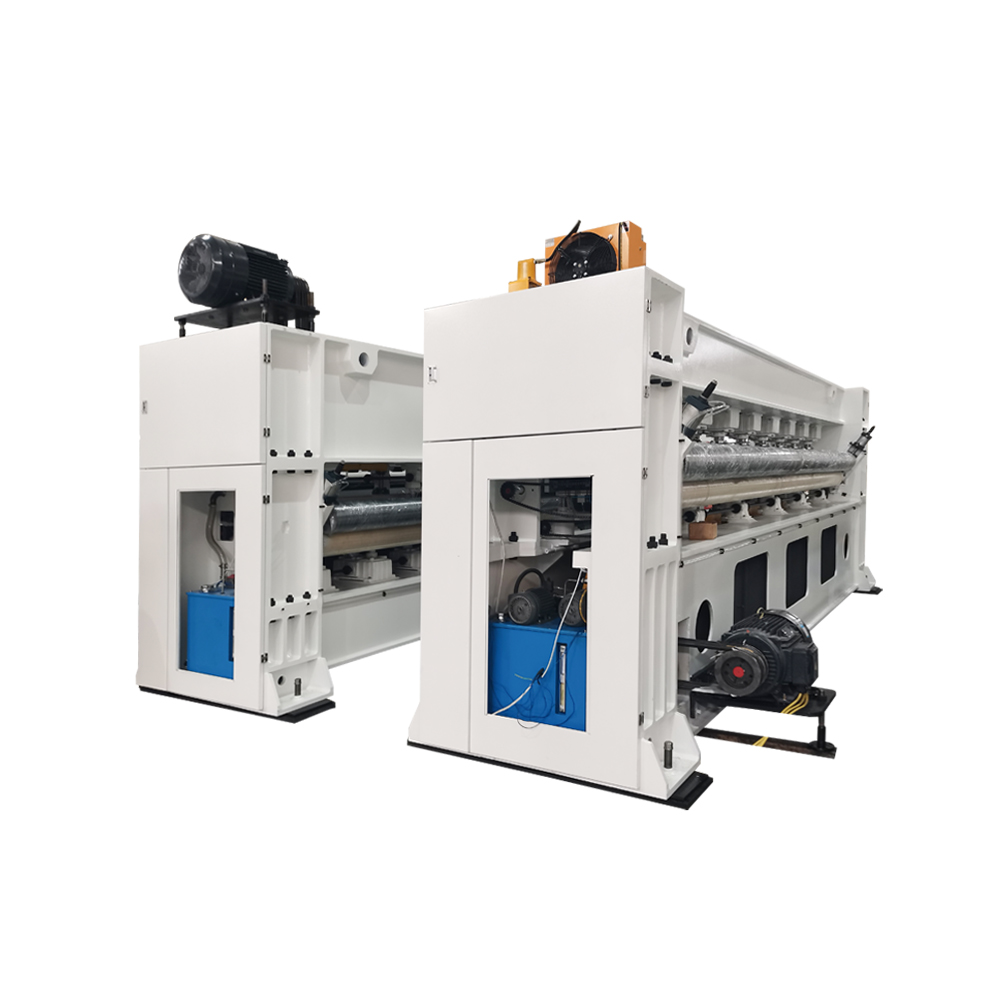
How Needle Punch Machines Achieve Structural Reinforcement in Nonwovens
Mechanical entanglement: The core mechanism of fibre bonding
A needle punch machine reinforces nonwoven fabrics by mechanically entangling fibres—without chemical binders or thermal fusion. Barbed needles drive through a pre-formed fibre web, carrying surface fibres into the interior; upon retraction, the barbs release them, leaving fibres interlocked in a stable 3D matrix. This physical bonding delivers high dimensional stability, controlled porosity, and multi-directional strength independent of yarn orientation. The resulting structure spans lightweight insulating batts to dense, abrasion-resistant felts—and layered needling enables gradient properties (e.g., a stiff core with a soft outer layer) using blended or dissimilar fibres. Because reinforcement is purely mechanical, performance remains reliable in chemically aggressive or thermally demanding environments, and pore size distribution can be precisely tuned for filtration, acoustic absorption, or drainage applications.
Key process parameters: Punch density, depth, and dwell time
Three interdependent parameters govern reinforcement efficiency:
- Punch density, measured in penetrations per cm² (typically 20–500), directly controls entanglement intensity—higher densities yield greater strength but risk fibre breakage if excessive.
- Needle penetration depth determines how far fibres are displaced vertically: deeper penetration enhances through-thickness cohesion and tensile integrity, while shallower strokes preserve surface loft and softness.
- Dwell time—the duration needles remain at maximum penetration—governs fibre relaxation and barb engagement effectiveness. It’s modulated via stroke frequency and feed rate: lower stroke frequency at a given line speed increases dwell time, promoting fibre reorientation and improving tensile strength and dimensional stability.
Balancing these parameters allows manufacturers to tailor nonwovens for geotextiles, automotive composites, and industrial filtration media—each requiring distinct structural priorities.
Critical Industrial Applications of Needle Punch Machines
Automotive composites: Headliners, door panels, and acoustic insulation
Needle punch machines are essential to producing lightweight, durable nonwoven composites used in modern vehicle interiors—including headliners, door panels, and acoustic insulation layers. Mechanical entanglement delivers consistent density, high tensile strength, and superior sound absorption without added weight or chemical binders. Automated systems enable precise control over punch density and depth, ensuring uniformity across large production runs. Industry data shows that manufacturers adopting automated needle punch lines have reduced fabrication time by up to 30% while maintaining zero-defect quality targets for high-volume orders. This efficiency supports automakers’ sustainability goals: needle-punched fabrics readily incorporate recycled fibres and eliminate volatile organic compound (VOC)-emitting adhesives—contributing to quieter, lighter cabins that meet both regulatory acoustic standards (e.g., ISO 10140-2) and brand-specific durability benchmarks.
Geotextiles and civil engineering reinforcement for soil stabilization
In civil engineering, needle punch machines produce nonwoven geotextiles engineered for soil stabilization, erosion control, and drainage. The barbed needle action creates a robust, dimensionally stable fabric with calibrated pore size—permitting high hydraulic conductivity while retaining fine soil particles. These materials are widely deployed in road subbases, embankment reinforcement, landfill liners, and coastal protection works, often replacing conventional granular layers and reducing overall project costs. Case studies from recent infrastructure projects demonstrate a 25% increase in service life compared to traditional methods, attributed to the fabric’s exceptional puncture resistance and long-term hydraulic stability. Production lines can dynamically adjust fabric weight, thickness, and tensile strength to match site-specific requirements—and compatibility with recycled PET or PP fibres aligns with green building certifications like LEED and BREEAM. As governments prioritize climate-resilient infrastructure, demand for needle-punched geotextiles continues to grow, underpinned by their proven role in reinforcing marginal soils and extending asset lifespans.
Integration of Needle Punch Machines in End-to-End Nonwoven Production Lines
Synchronization with carding, web formation, and post-bonding treatments
A needle punch machine functions most effectively when tightly synchronized with upstream and downstream equipment. Carding engines must first open and align staple fibres into a uniform batt; cross-lappers then layer this batt to achieve target thickness and isotropy. Speed coordination among card, lapper, and needle loom is critical—any mismatch introduces density variations or weak zones that compromise final performance. After mechanical entanglement, the semi-finished web often proceeds directly into post-bonding treatments such as thermal calendering or low-additive chemical bonding—used selectively to enhance surface integrity, dimensional lock, or abrasion resistance without undermining the fabric’s inherent breathability or recyclability. Fully integrated lines employ centralized PLC control to adjust punch density, dwell time, and line speed in real time, sustaining throughput rates up to 500 kg/h with minimal manual intervention. This seamless flow—from raw fibre to finished roll—transforms loosely assembled webs into robust, specification-grade nonwovens ready for conversion.
Optimizing Needle Punch Machine Performance for Reinforcement Efficiency
Optimizing reinforcement efficiency requires precise calibration—not just of process parameters, but of hardware and maintenance protocols. Needle gauge, barb geometry, and hook angle significantly influence fibre displacement and bond strength: finer needles with optimized barb spacing improve tensile performance while minimizing breakage in delicate or blended webs. Equally important is consistent mechanical condition—regular inspection and replacement of needle boards, stripping plates, and bed plates ensure uniform penetration depth and prevent skipped or double-punched zones. Modern machines integrate real-time monitoring systems that auto-adjust feed rate and stroke frequency in response to web thickness fluctuations, maintaining optimal entanglement across variable inputs. According to industry benchmarks, systematic optimization of these variables can increase tensile strength by up to 25% and extend geotextile service life by a comparable margin. Crucially, integration with upstream carding and downstream thermal finishing in a synchronized line reduces material waste by up to 12% and improves overall equipment effectiveness (OEE). Operators must balance mechanical stress against functional outcomes: over-punching may induce excessive stiffness or reduce permeability, compromising acoustic or filtration performance. A data-driven, holistic approach—grounded in material science and real-world application feedback—ensures needle-punched reinforcements consistently meet the rigorous structural demands of automotive, civil engineering, and industrial filtration markets.
FAQ Section
What is a needle punch machine?
A needle punch machine is a mechanical equipment that reinforces nonwoven fabrics by entangling fibres using barbed needles, without relying on chemical binders or thermal fusion.
What are the key parameters for optimizing reinforcement with needle punch machines?
The key parameters include punch density, needle penetration depth, and dwell time, which together govern fibre entanglement, tensile strength, and fabric integrity.
How are needle punch machines used in automotive applications?
Needle punch machines create durable, lightweight nonwoven composites for headliners, door panels, and acoustic insulation while supporting sustainability by eliminating VOC-emitting adhesives.
What role do needle punch machines play in civil engineering projects?
They produce geotextiles for soil stabilization, erosion control, and drainage, offering dimensional stability, hydraulic conductivity, and compatibility with recycled fibres.
How can needle punch machine performance be optimized?
Performance can be optimized by calibrating needle gauge, barb geometry, dwell time, and maintaining mechanical conditions such as needle boards and plates, ensuring high reinforcement efficiency and minimal waste.
Table of Contents
- How Needle Punch Machines Achieve Structural Reinforcement in Nonwovens
- Critical Industrial Applications of Needle Punch Machines
- Integration of Needle Punch Machines in End-to-End Nonwoven Production Lines
- Optimizing Needle Punch Machine Performance for Reinforcement Efficiency
-
FAQ Section
- What is a needle punch machine?
- What are the key parameters for optimizing reinforcement with needle punch machines?
- How are needle punch machines used in automotive applications?
- What role do needle punch machines play in civil engineering projects?
- How can needle punch machine performance be optimized?