
 EN
EN
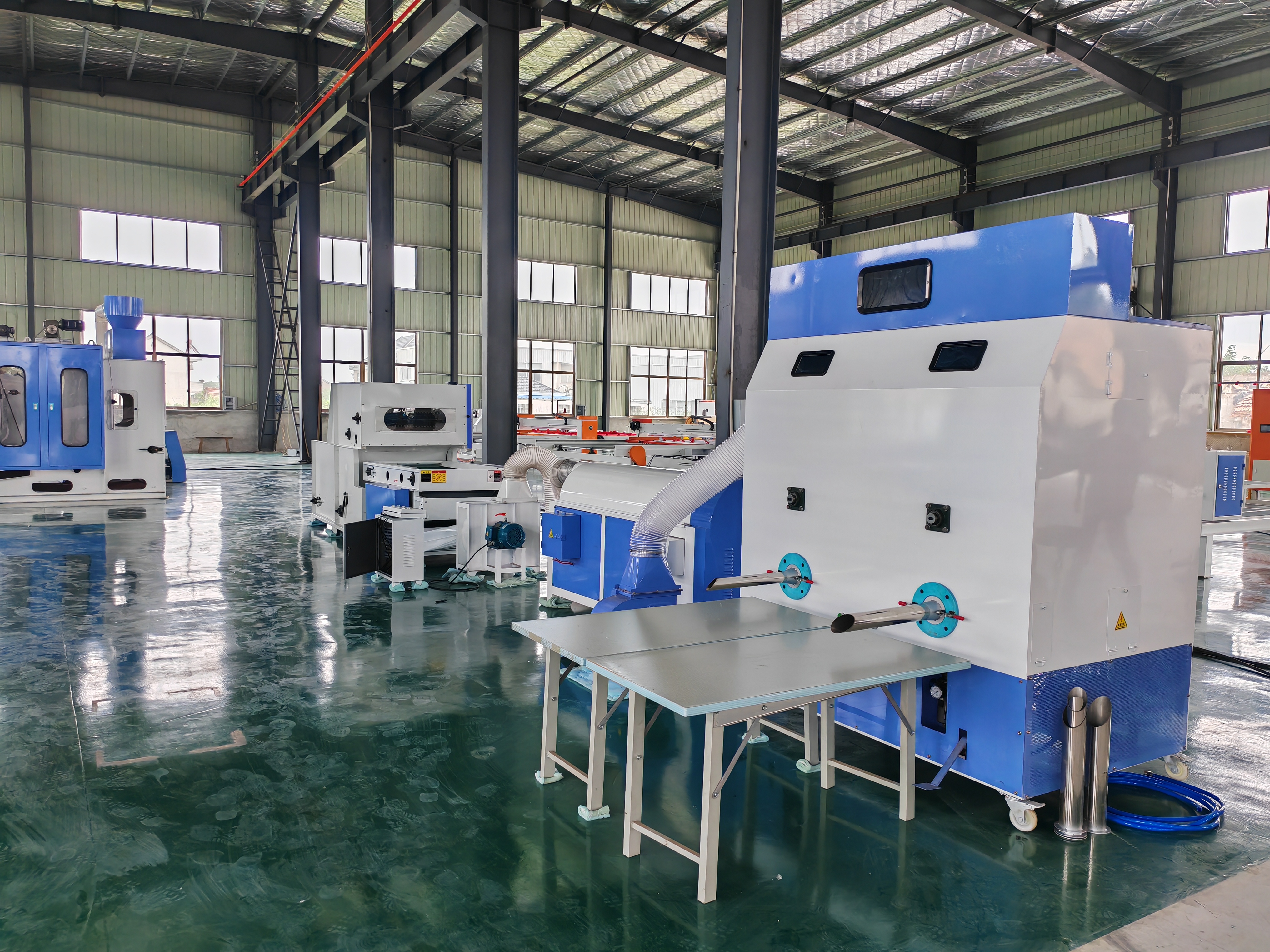
Core Applications of Fiber Filling Machines in Toy and Pillow Manufacturing
Streamlining high-volume stuffing for plush toys and supportive pillows
Fiber filling machines automate the most labor-intensive stage of soft-goods production: the precise, repeatable insertion of fill material into fabric shells. In high-volume runs, a single advanced machine can replace four to six manual operators—slashing labor hours while eliminating the inconsistency inherent in hand-stuffing. Regulated airflow and controlled feed mechanisms ensure each plush toy or pillow receives the exact programmed amount of fill, whether hypoallergenic polyester fiberfill, silicone-coated hollowfiber, or shredded memory foam. This uniformity directly reduces rework caused by under- or over-stuffed items. For manufacturers producing thousands of units daily, the result is a steady, uninterrupted flow from cutting table to packaging line—with minimal downtime and output that reliably meets tight retail deadlines. Closed-loop systems also minimize fiber waste by containing loose fill, transforming a traditionally messy process into a clean, efficient operation.
Adapting to diverse product profiles: from small plush animals to large orthopedic pillows
The same fiber filling machine can be reconfigured in minutes to handle an astonishing range of product sizes and shapes. With a quick nozzle change and digital control panel adjustment, operators switch seamlessly from stuffing a delicate 15-centimeter keychain plush to a full-size contoured memory foam pillow. This flexibility is essential for producers managing mixed SKU portfolios. For small plush animals, gentle but precise fill pressure prevents seam tears and feature distortion; for large orthopedic pillows, it delivers the high-density, layered fill required to maintain ergonomic support. Programmable fill profiles—each with unique weight, density, and airflow settings—enable production of both soft, squeezable children’s toys and firm cervical pillows on the same line, without cross-contamination. This adaptability expands product range and future-proofs the investment, as new shapes or materials can be added simply by updating software parameters.
Enhanced Production Efficiency with Fiber Filling Machines
Throughput gains: 3–5x faster output vs. manual filling
The primary driver for adopting automated fiber filling is the dramatic increase in production speed. A fiber filling machine consistently achieves throughput rates three to five times higher than manual stuffing operations—a gain documented in the 2023 TAPPI Packaging Report. This acceleration reshapes production planning: tasks once requiring a full shift can now be completed in a fraction of the time, enabling manufacturers to meet surge demand for seasonal toys or promotional pillow lines without temporary staffing. By executing precise, automated fill-and-cut cycles in seconds, the machine eliminates bottlenecks caused by human fatigue and variability—ensuring steady, predictable output of finished goods.
Operational metrics: OEE at 87% vs. 61% for semi-automated lines
Beyond raw speed, Overall Equipment Effectiveness (OEE) reveals the true productivity advantage. According to the 2024 PMA Survey, a dedicated fiber filling machine achieves an OEE of 87%, dramatically outperforming the 61% typical of semi-automated lines. This 26-point gap reflects the limitations of hybrid systems where manual operators must synchronize with basic blowers. Fully automated machines minimize downtime by eliminating pauses for manual positioning and adjustment. Their consistent performance score reflects near-continuous operation at optimal speed, while their high quality score means virtually no products are rejected due to fill errors. The result is a workstation transformed from a variable, often idle point into a reliable, profit-generating asset.
Consistent, High-Quality Output Enabled by Fiber Filling Machines
Precision weight control: reducing fill variance from ±8% (manual) to ±1.5%
A fiber filling machine transforms one of the most variable steps in production into a model of repeatability. Manual filling typically exhibits ±8% fill weight variance—driven by operator fatigue and inconsistent technique—leading to material waste, product giveaways, and consumer complaints. Automated systems leverage servo-driven augers or volumetric dosing to achieve a tight ±1.5% variance. This precision delivers tangible savings: for a mid-sized plant processing 200,000 kg of fiber annually, narrowing variance from 8% to 1.5% saves over 13,000 kg of raw material. Real-time feedback from integrated check-weighers enables micro-adjustments on the fly—ensuring every cushion or toy limb receives its exact programmed fill weight without constant human oversight.
Eliminating lumps, voids, and density inconsistencies—critical for pillow ergonomics and toy safety
Precision weight control is only part of the story—the machine’s ability to ensure uniform distribution is equally vital. Manual stuffing frequently creates lumps, voids, and density inconsistencies that compromise function and safety. In pillows, dense lumps generate pressure points that disrupt spinal alignment, undermining ergonomic benefits. In plush toys, voids can shift during use, causing shape loss—and more critically, violating safety standards if fibers bunch into hazardous configurations. Automated systems address this through multi-stage blowing and carding mechanisms that open, aerate, and inject fiber in a predictable, layered pattern. The result is homogenous density: pillows retain supportive loft under sustained use, and toys pass rigorous compression and deformation tests—delivering comfort backed by demonstrable safety.
Material Versatility: Optimizing Fiber Filling Machines for Diverse Fill Types
Calibrated airflow and feed systems for polyester fiber, hollowfiber, and shredded memory foam
A fiber filling machine’s versatility across fill types rests on precisely calibrated airflow and feed systems. Lightweight polyester fiber requires gentle pneumatic conveyance to prevent clumping; denser shredded memory foam demands high-torque auger feeds and controlled air pressure to avoid bridging; hollowfiber needs anti-static nozzles and fine-tuned airflow to ensure even distribution without breakage. Such calibration maintains fill variance at ±1.5% and cuts material waste by up to 30%, as reported in the 2023 Manufacturing Efficiency Report. This adaptability allows manufacturers to switch between fill types in minutes—supporting rapid, reliable product changeovers without sacrificing consistency or compliance.
FAQ Section
What is the primary purpose of fiber filling machines?
Fiber filling machines are designed to automate the insertion of fill material into products like toys and pillows, ensuring precision, reducing labor, and enhancing production efficiency.
What materials can fiber filling machines handle?
Fiber filling machines can handle various materials including hypoallergenic polyester fiberfill, silicon-coated hollowfiber, and shredded memory foam with calibrated settings to optimize efficiency.
How do these machines ensure consistent product quality?
Automated systems use regulated airflow, controlled feed mechanisms, and real-time feedback to minimize fill variance and prevent inconsistencies such as lumps or voids.
Can fiber filling machines handle different product sizes and shapes?
Yes, fiber filling machines offer the flexibility to quickly adapt to different product shapes and sizes by adjusting nozzle types and programmable settings.
What is the efficiency improvement of using these machines compared to manual methods?
Fiber filling machines significantly increase production speed, achieving outputs 3–5x faster and improving operational metrics like OEE from 61% to 87% compared to semi-automated systems.