
 EN
EN
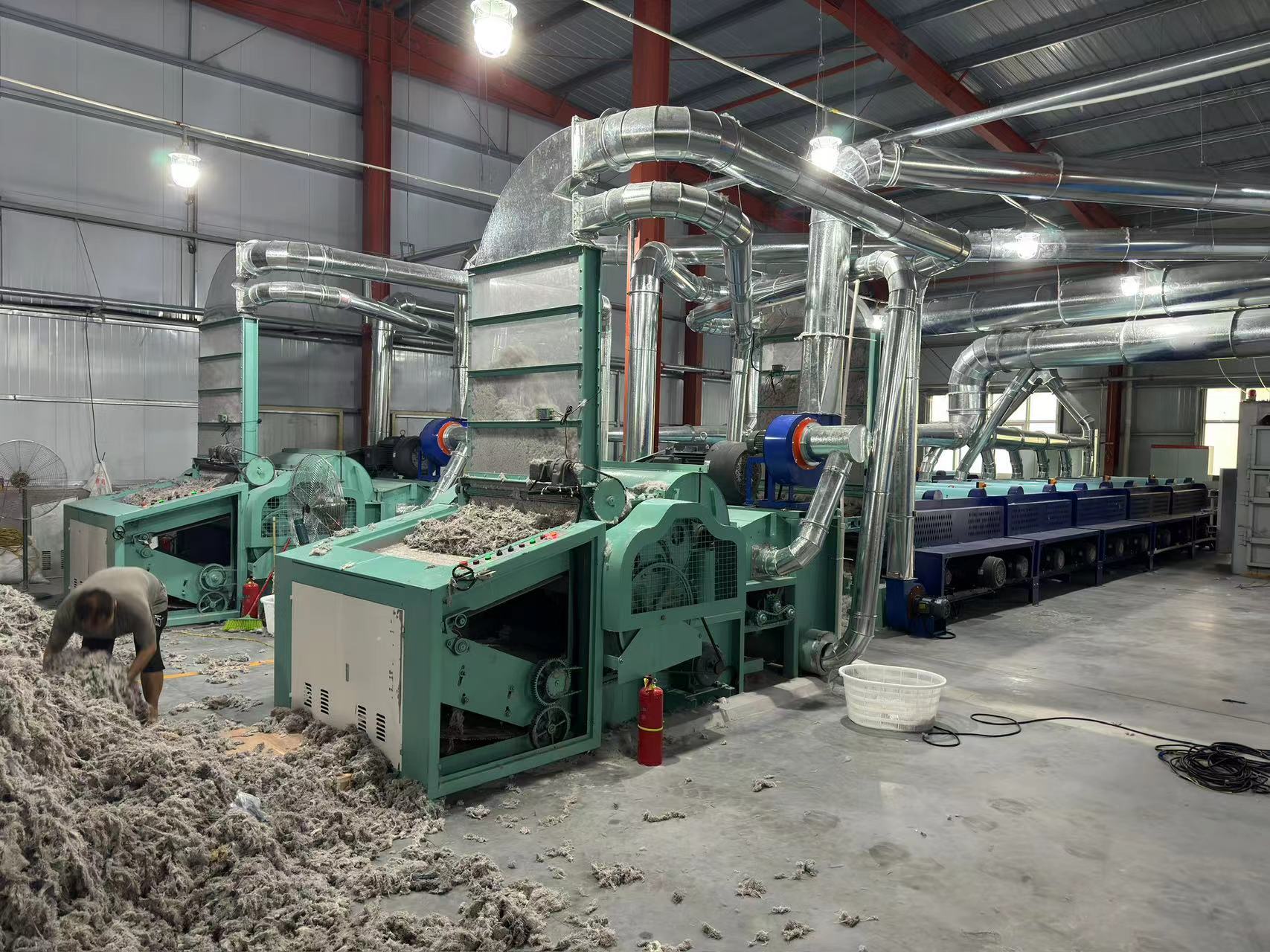
Why Textile Waste Recycling Machines Are Essential for Circularity and Compliance
The Global Textile Waste Crisis and Regulatory Drivers
The fashion industry generates over 92 million tons of textile waste annually, per the United Nations Environment Programme. In Europe alone, post-consumer textile waste totals 7–7.5 million tons per year—and is projected to rise to 8.5–9 million tons by 2030. Yet only 30–35% of household textile waste is collected, and just 1–2% undergoes fiber-to-fiber recycling; the remainder is landfilled or incinerated. This linear “take-make-waste” model is no longer sustainable—nor compliant.
Regulatory pressure is accelerating: the EU Waste Framework Directive requires member states to implement separate textile waste collection systems by 2025. Producer responsibility organizations (PROs) are further driving change, targeting 50% collection of post-consumer waste by 2030. Without scalable, industrial-grade recycling infrastructure—including dedicated textile waste recycling machines—brands and manufacturers face escalating compliance risk, supply chain disruption, and reputational harm. These machines are no longer optional; they are foundational to regulatory alignment, resource resilience, and credible circular strategy.
How Modern Textile Waste Recycling Machines Close the Loop
Today’s advanced textile waste recycling machines transform end-of-life fabrics into high-integrity recyclates ready for reintroduction into production. Systems combining near-infrared (NIR) sorting with chemical dissolution handle complex blends and deliver fibers meeting virgin-quality benchmarks and strict traceability standards for circular manufacturing. Modular designs enable seamless integration into existing lines—reducing manual handling, minimizing contamination, and improving process reliability. Automation ensures consistent output quality, a non-negotiable requirement when supplying recycled feedstock to spinning mills or nonwoven fabricators.
By closing the loop on both pre- and post-consumer waste, these machines let manufacturers replace virgin inputs with verified recycled content—cutting embodied carbon and insulating operations from commodity price volatility. In doing so, they convert regulatory obligation into strategic advantage: circularity becomes not just technically viable but economically compelling.
Key Textile Waste Recycling Machine Technologies Compared
Mechanical vs. Chemical Recycling: Output Quality and Feedstock Limits
Mechanical recycling physically shreds, cards, and respins textiles without altering their chemical structure. It accounts for over 90% of recycled textiles in Europe (European Environment Agency), offering lower energy use and emissions than chemical alternatives—making it cost-effective for pure cotton, wool, and certain polyester streams. However, fiber length degrades with each cycle, limiting mechanical output to downcycled applications like insulation or wipes. It also falters with blended fabrics: even trace elastane or nylon can cause machine jams or yarn weakness.
Chemical recycling breaks polymers down to monomers via depolymerization (e.g., glycolysis, hydrolysis), enabling true fiber-to-fiber regeneration. It handles polyester-dominant blends and yields virgin-equivalent fibers—but demands higher capital investment, greater energy input, and more complex chemistry. While mechanical recycling scales rapidly—evidenced by a leading thermo-mechanical recycler processing 2,500 tonnes in 2024 and targeting >10,000 tonnes by 2030—chemical routes remain largely confined to pilot-scale operations outside of simple PET waste streams.
Emerging Biological and Thermal Methods: Scalability and Commercial Readiness
Biological recycling uses enzymes or microbes to depolymerize natural fibers like cotton into glucose, which can be fermented into bioethanol or platform chemicals. Operating at mild temperatures with high specificity, it holds promise for low-impact processing—but remains slow, feedstock-sensitive (requiring high-purity cellulose), and prohibitively expensive. No commercial textile waste recycling machine based on enzymatic hydrolysis is yet deployed at scale.
Thermal methods—including gasification and pyrolysis—convert mixed textile waste into syngas or oils through controlled heat and partial oxidation. Gasification is the most mature thermal route, with proven commercial deployment in municipal solid waste treatment; adapting it to textiles requires only minor engineering adjustments. Its ability to accept all fiber types—including polycotton, elastane, and nylon—makes it uniquely suited to the ~60% of discarded textiles currently deemed unrecyclable. Still, high capital costs and energy intensity constrain adoption—particularly for closed-loop fiber recovery. Today, thermal technologies primarily serve waste-to-energy markets rather than circular material loops.
Solving the Blended Fabric Challenge with Smart Textile Waste Recycling Machines
Why 60% Blended Fibers Stymie Traditional Recycling
Over 60% of discarded textiles are blends—most commonly polycotton—where synthetic and natural fibers are fused at the yarn or fabric level. Conventional mechanical recycling machines cannot disentangle these materials. The result is low-value, heterogeneous output fit only for downcycling—not circular regeneration. Chemical separation methods exist but often rely on aggressive solvents, high energy, and large water volumes, undermining environmental gains. Without dedicated separation technology, this majority share of the waste stream flows straight to landfill or incineration—blocking progress toward true circularity. Unlocking this vast feedstock pool hinges on overcoming the fundamental challenge of fiber separation.
AI-Driven Sorting and NIR Spectroscopy in Next-Gen Machines
Next-generation recycling lines integrate NIR spectroscopy to identify fiber composition at line speed—scanning thousands of items per hour. AI algorithms interpret spectral signatures in real time, directing precision air jets to divert garments into discrete, high-purity streams: cotton, polyester, or polycotton. Accuracy exceeds 95%, drastically cutting manual sorting labor and contamination. Once isolated, polycotton fractions can enter specialized chemical stages where cellulose is dissolved while polyester remains intact for repolymerization.
This intelligent, multi-stage approach transforms previously unrecyclable mixed bales into verified, market-ready feedstocks—turning systemic complexity into scalable, profitable circularity.
Monetizing Output: Revenue Streams Enabled by Textile Waste Recycling Machines
Transitioning from disposal to circular processing converts a cost center into a revenue generator. Every tonne of textile waste processed yields sellable outputs—recovered fibers, purified monomers, or energy-dense fuels—with tangible market value. Boston Consulting Group estimates that raising the global fiber-to-fiber recycling rate above 30% could unlock over $50 billion in raw material value. In Europe, fiber-to-fiber recycling is projected to generate €2–€3 billion in annual revenue by 2030 (McKinsey). These figures reflect growing investor and operator confidence in the business case for advanced machinery.
Revenue emerges across tiers of the value chain. Mechanical lines produce shredded fibers and pellets sold to nonwoven, insulation, or automotive felt producers. Chemical systems yield polymer pellets and monomers suitable for premium apparel-grade fabrics—commanding price premiums. Even residual fractions find value: compacted mixed-fiber bales serve construction (acoustic insulation) and agriculture (erosion control). Success depends on aligning machine capabilities—sorting fidelity, refinement depth, and output flexibility—with the highest-margin off-take channels. As commodity prices shift, adaptable machines allow operators to pivot between streams and maximize per-tonne returns.
Market pull reinforces profitability. Major apparel brands and retailers are actively sourcing certified recycled content to meet science-based targets and consumer expectations—creating reliable demand. Industrial buyers increasingly view recycled fiber as a price-stable alternative to volatile virgin inputs. When integrated within local collection ecosystems, recycling machines also generate income from processing fees and reduce logistics costs. The resulting multi-layered model—combining avoided disposal fees, material sales, and service contracts—enables rapid ROI and positions textile waste recycling as a durable, high-margin enterprise.
FAQs
Why are textile waste recycling machines important?
Textile waste recycling machines are essential for reducing the environmental impacts of textile waste, complying with growing regulations, and supporting the transition to a circular textile economy. They help convert waste into valuable raw materials, reducing reliance on virgin resources.
What technologies are used in textile waste recycling machines?
These machines employ a variety of technologies, including mechanical recycling, chemical recycling, AI-driven NIR spectroscopy sorting, and emerging methods such as biological and thermal processes to optimize recovery and recycling of textiles.
What challenges do blended fibers pose for recycling?
Blended fibers, such as polycotton fabrics, are difficult to separate using traditional recycling methods, resulting in low-value output. Advanced technologies like NIR spectroscopy and specialized chemical processes are essential for efficiently recycling these materials.
How do textile waste recycling machines generate revenue?
Textile waste recycling machines create revenue from recovered material sales, avoided disposal costs, and processing fees. Recovered fibers and other byproducts are sold to manufacturers targeting recycled textiles or alternative applications like construction and insulation.
Is chemical recycling better than mechanical recycling?
Chemical recycling enables true fiber-to-fiber regeneration with higher quality output, especially for blended fabrics, but requires higher capital and energy investments. Mechanical recycling, while cost-effective, is best suited for pure fiber types and results in downcycled products more often.
Table of Contents
- Why Textile Waste Recycling Machines Are Essential for Circularity and Compliance
- Key Textile Waste Recycling Machine Technologies Compared
- Solving the Blended Fabric Challenge with Smart Textile Waste Recycling Machines
- Monetizing Output: Revenue Streams Enabled by Textile Waste Recycling Machines
- FAQs