
 EN
EN
How Textile Waste Composition Dictates Machine Selection
Why Fiber Type (Cotton, Polyester, Wool, Blends) Determines Recycling Feasibility
Each fiber type behaves fundamentally differently during recycling—dictating not just whether recovery is possible, but how it must be done. Cotton fibers are short and brittle after mechanical tearing, so machines must minimize length degradation to preserve staple integrity for reuse in spun yarns or nonwovens. Polyester, by contrast, can be depolymerized chemically into monomers like BHET, requiring reactor vessels—not shredders—for closed-loop recycling. Wool is resilient but highly sensitive to heat, alkali, and oxidative damage, demanding low-temperature, pH-neutral processing to retain tensile strength and crimp. Blends combine these incompatible traits: mechanical systems that work for cotton destroy polyester’s molecular weight, while solvent-based reactors cannot process natural fibers without degradation. Machine design must therefore align precisely with dominant fiber streams—using a cotton-optimized shredder on polyester pellets risks compaction and melting, while deploying a chemical dissolution system on 100% wool waste introduces unnecessary cost and hazard. Understanding your feedstock’s fiber composition isn’t a preliminary step—it’s the foundational criterion for equipment selection, directly impacting material value retention, operational reliability, and regulatory compliance.
The Polycotton Challenge: Why Conventional Textile Waste Recycling Machines Struggle with Mixed Fibers
Polycotton blends—most commonly 50% cotton and 50% polyester—are among the most prevalent textile wastes globally, yet they systematically defeat conventional mechanical recycling lines. Standard shredders and air-separation systems cannot distinguish between cellulose and synthetic fibers at the molecular level; they produce a heterogeneous flock contaminated with undetected polyester shards in cotton streams—and vice versa—rendering output unsuitable for fiber-to-fiber recycling. This limitation forces recyclers into costly trade-offs: downcycling into low-value insulation or wiping cloths, or landfilling entirely. Breaking this deadlock requires upstream fiber identification—not downstream correction. Advanced sorting technologies like near-infrared (NIR) spectroscopy, integrated into high-speed conveyor systems, enable real-time, non-destructive fiber classification. When paired with precision air-jet ejection or robotic sorting, NIR allows clean separation of cotton and polyester fractions from mixed waste—enabling each stream to enter its optimal recycling pathway. As noted by the European Environment Agency, such sorting capability is now a prerequisite for economically viable polycotton recycling at scale.
Key Textile Waste Recycling Machine Types and Their Operational Fit
Selecting the right textile waste recycling machine begins with understanding the primary machine categories available. Each serves a distinct role in the recycling chain—from initial breakdown to final fiber separation—and directly influences the quality, yield, and market readiness of recovered materials.
Shredders and Fiber Openers: Essential First-Stage Machines for Pre-Processing
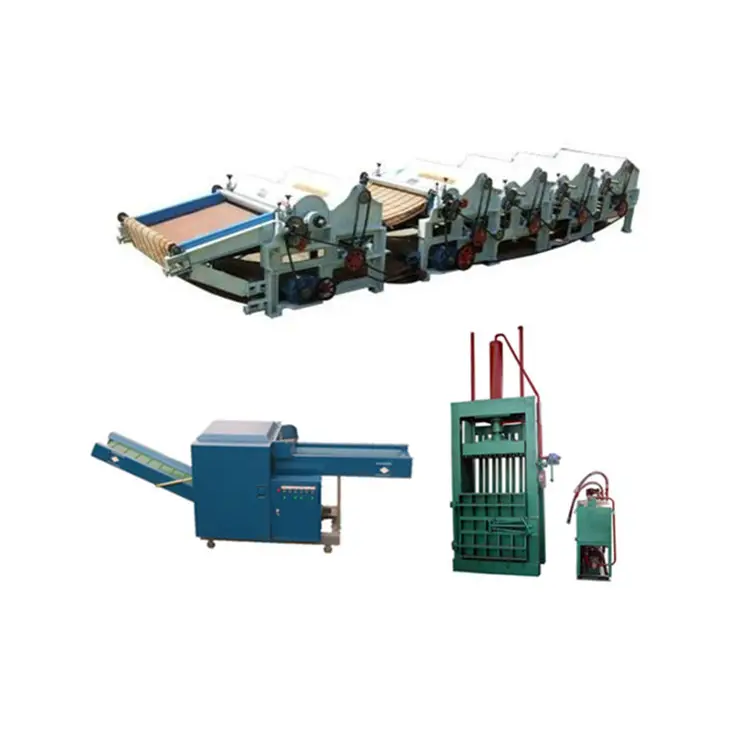
Shredders and fiber openers form the indispensable first stage in any mechanical textile recycling line. Designed to accept bulk post-consumer garments, production offcuts, and industrial trimmings, these machines mechanically reduce consolidated textiles into loose, opened fibers through cutting, tearing, and beating actions. Their performance varies significantly by fiber: cotton and wool respond well to aggressive opening, yielding fluffy, cardable fiber ideal for nonwovens or re-spinning; polyester requires gentler handling to avoid pelletization or thermal fusion. For example, post-consumer mattress covers are routinely shredded to recover reusable textile fibers, while knitted cotton fabric waste can be processed via suspension-based fiber opening to produce carbonized textile substrates. By transforming heterogeneous waste into a uniform, flowable feedstock, shredders and openers ensure downstream equipment—such as separators, cleaners, or extruders—operates reliably and efficiently. They remain essential for high-volume operations, especially where feedstock is predominantly single-fiber or pre-sorted.
AI-Powered Sorting Systems: Precision Machines for High-Yield Fiber Separation
For facilities handling blended textiles—particularly cotton-polyester mixes—AI-powered sorting systems represent a decisive technological leap in separation fidelity. These machines integrate near-infrared (NIR) spectroscopy with high-resolution imaging and machine learning algorithms to identify fiber composition at speeds exceeding 10 tons per hour. Once classified, automated air jets or robotic arms divert individual fragments into dedicated output chutes—achieving >98% purity in both cotton and polyester fractions from previously unrecyclable polycotton waste. Unlike solvent-based or ionic liquid methods—which require chemical recovery infrastructure and generate hazardous waste—AI sorting delivers a scalable, mechanical alternative with lower capital and operating costs. According to a 2023 study published in Resources, Conservation & Recycling, facilities adopting NIR-guided sorting saw a 42% increase in high-grade fiber yield and a 30% reduction in post-sort contamination-related rework. This precision directly enhances resale value, supports brand sustainability commitments, and enables participation in circular supply chains requiring certified recycled content.
Evaluating Economic and Technical Performance of Textile Waste Recycling Machines
When selecting a textile waste recycling machine, businesses must rigorously weigh throughput, energy use, output quality, and total cost of ownership—not in isolation, but as interdependent variables shaped by feedstock composition and end-market requirements. Higher throughput often demands more energy, but next-generation designs now cut power consumption per ton by up to 25%. Output quality—measured in fiber length retention, polymer molecular weight, and compositional purity—determines whether recycled material qualifies as direct virgin replacement in premium applications like apparel or automotive textiles. Managers should calculate true cost per ton, factoring in energy, maintenance, labor, solvent recovery (if applicable), and the market premium—or discount—associated with output grade.
Throughput, Energy Efficiency, and Output Quality: Critical Trade-Offs in Machine Selection
Throughput quantifies processing capacity—typically expressed in tons per hour—and sets the upper limit on operational scale. Energy efficiency is measured in kWh per ton, reflecting how effectively the machine converts input energy into useful output. While high-throughput systems draw more total power, advanced engineering—such as variable-frequency drives, optimized rotor geometry, and regenerative braking—lowers per-unit energy demand. Output quality encompasses three critical dimensions: for cotton, staple length and micronaire; for polyester, intrinsic viscosity (IV) and BHET monomer yield; and for all fibers, absence of contaminants like zippers, dyes, or mixed polymers. Some machines achieve ultra-high purity through multi-stage separation—sacrificing speed for consistency—while others prioritize volume, yielding lower-grade output suitable for industrial wipes or acoustic insulation. The optimal configuration depends on your target application: a denim brand sourcing recycled cotton for premium jeans needs length-preserving openers and NIR sorting; a carpet manufacturer using polyester flake for backing may prioritize glycolysis throughput over cotton recovery.
Comparing Advanced Systems: Solvent-Based Dissolution vs. Glycolysis Depolymerization Machines
Solvent-based dissolution—using systems like N-Methylmorpholine N-oxide (NMMO) or ionic liquids—selectively dissolves cellulose from blended waste, recovering intact cotton fiber and undamaged polyester simultaneously. It preserves fiber quality for high-value reuse but demands significant capital investment, stringent solvent recovery, and specialized safety protocols. Glycolysis depolymerization, in contrast, targets polyester exclusively: it breaks down polymer chains into bis(2-hydroxyethyl) terephthalate (BHET) monomers using ethylene glycol and catalysts, enabling true closed-loop polyester recycling. It works on pure polyester or polyester-rich blends—but leaves cotton as an insoluble residue requiring separate handling. A 2022 life-cycle assessment by the Ellen MacArthur Foundation found dissolution systems consume ~35% more energy than glycolysis per ton of polyester recovered, but deliver dual-stream value where cotton markets support premium pricing. Businesses processing large volumes of post-industrial polyester scraps may favor glycolysis for its scalability and lower chemical complexity; those targeting branded, blended post-consumer collections—especially in regulated markets like the EU—often invest in dissolution to meet extended producer responsibility (EPR) and recycled content mandates.
Matching Machine Capabilities to Your Business Scale and Goals
Selecting the right textile waste recycling machine requires aligning its technical capabilities with your current throughput, feedstock profile, and strategic growth trajectory. A small operation processing 2–5 tons weekly—such as a regional textile remanufacturer or upcycling studio—may benefit from a compact, semi-automated fiber opener with manual sorting integration, keeping upfront investment under €200,000 while maintaining flexibility. In contrast, a large industrial facility handling 100+ tons daily—like a global apparel supplier fulfilling GRS-certified commitments—requires a fully automated, modular line with NIR sorting, continuous feed control, and real-time quality monitoring to sustain efficiency and traceability. Scalability is non-negotiable: machines designed with plug-and-play modules—such as add-on separator units or retrofittable AI vision kits—allow phased upgrades without full system replacement. Equally critical is total cost of ownership: energy-efficient motors, predictive maintenance alerts, and standardized spare parts reduce long-term OPEX. By matching machine speed, fiber-specific handling capacity, automation level, and data integration to your business goals—not just today’s volume—you secure ROI, future-proof operations, and avoid costly downtime as demand expands or regulations tighten.
FAQ
Why is fiber composition critical in textile waste recycling?
Fiber composition dictates the type of machine needed for recycling and affects the quality and usability of the recovered materials.
How do AI-powered sorting systems enhance recycling efficiency?
They use near-infrared spectroscopy and machine learning to segregate fibers with high precision, ensuring purity and maximizing yield.
What are the main challenges with polycotton blends in recycling?
Polycotton blends cannot be separated efficiently by conventional systems, often leading to downcycling or landfill disposal.
Which factors should businesses consider when selecting recycling machines?
Key factors include throughput, energy efficiency, fiber-specific handling capacity, and total cost of ownership.
What are solvent-based dissolution and glycolysis machines, and how do they differ?
Solvent-based systems dissolve cellulose to recover cotton and polyester, while glycolysis targets polyester recycling. They differ in cost, energy consumption, and fiber handling capabilities.
Table of Contents
- How Textile Waste Composition Dictates Machine Selection
- Evaluating Economic and Technical Performance of Textile Waste Recycling Machines
- Matching Machine Capabilities to Your Business Scale and Goals
-
FAQ
- Why is fiber composition critical in textile waste recycling?
- How do AI-powered sorting systems enhance recycling efficiency?
- What are the main challenges with polycotton blends in recycling?
- Which factors should businesses consider when selecting recycling machines?
- What are solvent-based dissolution and glycolysis machines, and how do they differ?